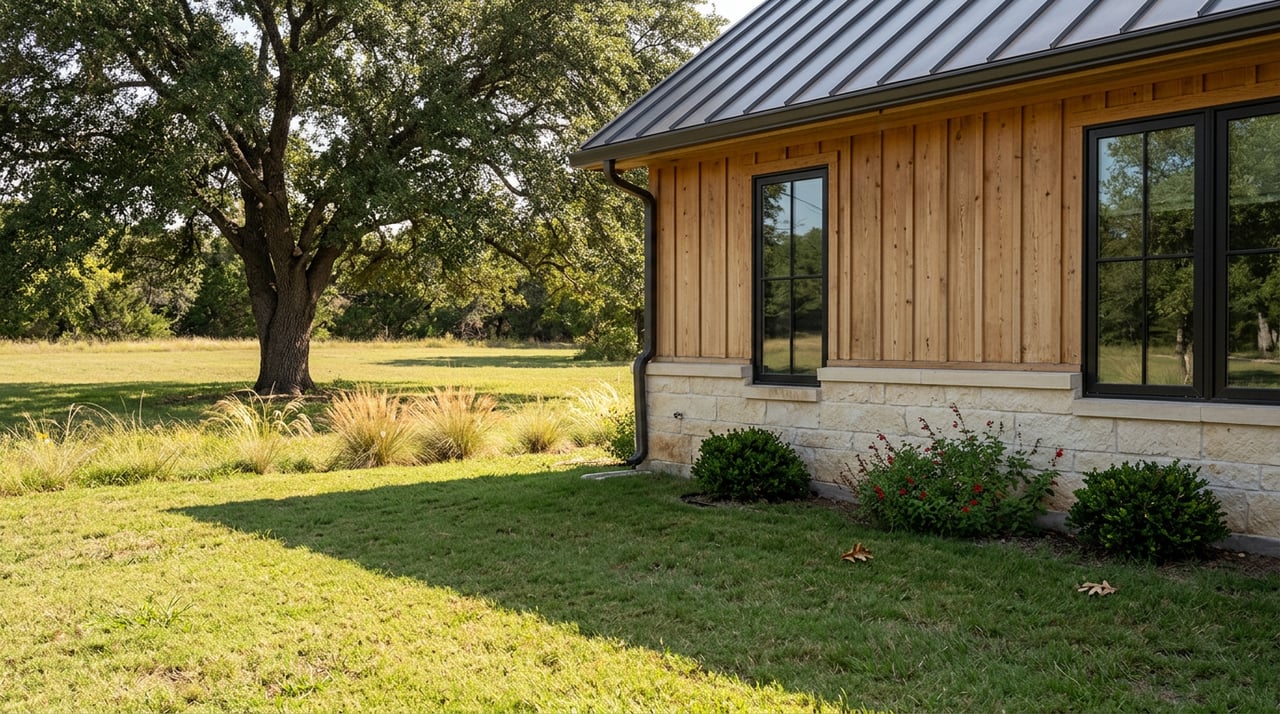
A buyer walks a 2.4-acre tract in Copper Canyon with a builder's site plan already in his head: main house near the road, a 30x40 shop set back toward the tree line, room left over for a small barn someday. The lot meets the town's zoning minimum. The setbacks from the property lines check out. Everything on paper says go.
Then the septic layout comes back from the site evaluator, and the shop has to move. Not because of a setback from the fence line. Because Copper Canyon's own code ties the location of any accessory building directly to the septic system already planned for that lot, and the town's OSSF inspector has to sign off on where the two sit relative to each other before a building permit gets issued. The property line was never the constraint. The drain field was.
The Ordinance Buyers Don't Find Until They're Under Contract
Copper Canyon's supplementary land use provisions state that on any lot with a septic system, accessory buildings cannot be sited in a way that interferes with routine maintenance, replacement, or repair of that system. The code goes further than most municipal ordinances on this point: a site plan showing both the septic layout and the proposed accessory structure has to be submitted to the town, and it's the town's own OSSF inspector, not just a private site evaluator, who reviews it for conflicts.
That detail matters because most buyers evaluating acreage assume the constraints on where they can build a shop or guest house come from setback lines and lot coverage rules. In Copper Canyon, the septic field functions as a second, invisible property line. A tract with generous acreage but a poorly placed or oversized drain field can end up with less usable building envelope than a smaller lot with a tighter, well-planned system. You cannot tell which situation you're buying into from a plat alone. You need the septic permit and site evaluation on file, and if one doesn't exist yet, you need to know that the shop or guest house you're planning has to be designed around a system that hasn't been laid out yet either.
Why Septic Is the Starting Point, Not an Afterthought
Copper Canyon has no municipal sewer system, and its large-lot character means almost every home in town runs on an on-site sewage facility regulated under the state's OSSF program. Texas sets the baseline rule for lots not served by public water: a single-family dwelling using an individual sewage system on land without public water access needs at least one acre. Copper Canyon's own minimum lot sizes sit above that floor, which is part of why the town has kept its rural feel, but it also means every buildable acre already has a sewage system claim on it before a shop or barn enters the picture.
The state's permitting exemption complicates this further rather than simplifying it. A single-family home on ten acres or more can skip the standard OSSF permit if a licensed evaluator confirms the system won't discharge across the property line, but that exemption removes a paperwork step, not the physical constraint. The system still needs the same setbacks and the same maintenance access, and Copper Canyon's own accessory-building rule still applies regardless of whether the OSSF technically required a permit or not.
Two Water Paths, Two Different Rulebooks
Where your water comes from changes which agency you're dealing with and what your buildable footprint looks like, and it's not always obvious from the listing which one applies to a given tract.
| Served by Cross Timbers Water Supply Corporation | Served by a private well | |
|---|---|---|
| Governing entity | Cross Timbers Water Supply Corporation (CCN holder) | North Texas Groundwater Conservation District |
| Minimum lot size for OSSF | No one-acre floor from this specific state provision, since public water is available | One acre minimum under state rule, since no public water is available |
| Permit trigger | Standard OSSF permit process through the town | Well registration required; production permit only if non-exempt |
| Exemption threshold | Not applicable | Wells under 17.36 gallons per minute are exempt from permitting, metering, and fees |
| Acreage requirement for exemption | Not applicable | None. The district does not set a minimum tract size for the exemption |
| Ongoing cost if non-exempt | Standard water bill | $0.10 per 1,000 gallons, or $1 per acre-foot for agricultural wells |
The well side of that table surprises a lot of buyers coming from other parts of Texas. Many groundwater districts only exempt domestic wells on tracts of ten acres or more, which pushes smaller-acreage buyers into a permitting process. The North Texas Groundwater Conservation District, which covers Collin, Cooke, and Denton Counties and was created by the state legislature in 2009, sets its exemption purely on well capacity, not tract size. A well on two acres that can't produce more than 17.36 gallons per minute is exempt the same way a well on forty acres would be. That's a real advantage for smaller Copper Canyon parcels planning to drill rather than connect, but it doesn't touch the septic setback rules, which still require distance from the well regardless of whether that well needed a permit.
The Growth Squeeze Behind the Meter
Cross Timbers Water Supply Corporation holds the water certificate for most of Copper Canyon, along with Bartonville, Double Oak, and parts of Highland Village and Flower Mound, serving roughly 3,000 homes and businesses across a 20-square-mile area as of last fall. The corporation was drilling a fifth well near the intersection of Copper Canyon Road and Orchid Hill Lane at that time, with completion targeted for the end of 2025 to keep pace with residential growth.
That capacity work isn't preventive maintenance on an easy system. A main break on Copper Canyon Road feeding the elevated tower serving the area pushed the utility into its most restrictive demand stage in the fall of 2024, cutting off outdoor irrigation entirely except for members already on private wells. It's a useful data point for anyone weighing whether to connect to Cross Timbers or drill independently: the system works, and it's actively expanding, but it has also hit the point where a single infrastructure failure meant a hard stop on outdoor water use for the whole service area until repairs finished.
None of this means a tract inside the CCN is a bad bet. It means the water source assigned to a specific parcel, and that utility's current capacity picture, is worth asking about directly rather than assuming from a neighboring property's setup.
What to Verify Before You Write
- Pull the septic permit and site evaluation for the specific tract, or confirm none exists yet if the lot is unimproved
- Ask whether the parcel falls inside Cross Timbers Water Supply Corporation's CCN or will need a private well
- If a well is the plan, check the well's intended capacity against the North Texas Groundwater Conservation District's 17.36 gallons-per-minute exemption threshold
- Confirm with the Town of Copper Canyon whether your proposed shop, barn, or guest house location has been checked against the septic layout by the town's OSSF inspector
- If the lot is under ten acres, plan on a standard OSSF permit rather than assuming the acreage exemption applies
FAQ
Does having a private well remove the need for a septic permit? No. Well and septic are regulated separately. A well being exempt from North Texas Groundwater Conservation District permitting has no bearing on whether the septic system needs a permit through the town or the state's ten-acre exemption.
If my lot is over ten acres, can I skip the septic site evaluation entirely? No. The acreage exemption removes the permit requirement in some cases, but a licensed site evaluator still has to confirm the system meets design standards and won't discharge across the property line. Copper Canyon's accessory-building rule also still applies.
Can I build the shop first and figure out septic placement later? Not without risk. Since the town requires the accessory building's location to be reviewed against the septic layout, building the shop before the septic system is designed and sited means the shop's location could end up in conflict with the drain field once the system is finalized.
Land in Copper Canyon rewards buyers who verify the mechanics before they fall in love with the acreage. If you're evaluating a tract for a custom build and want a second set of eyes on the water and septic picture before you write an offer, Ryan Stoddard can walk the numbers with you. Schedule a free consultation.